A woman suffered serious injuries after rotor downwash from an air ambulance helicopter knocked her over while she was filming its departure near Southend Airport. The circumstances were set out in a report published by the Air Accidents Investigation Branch (AAIB) on Thursday 12 November.
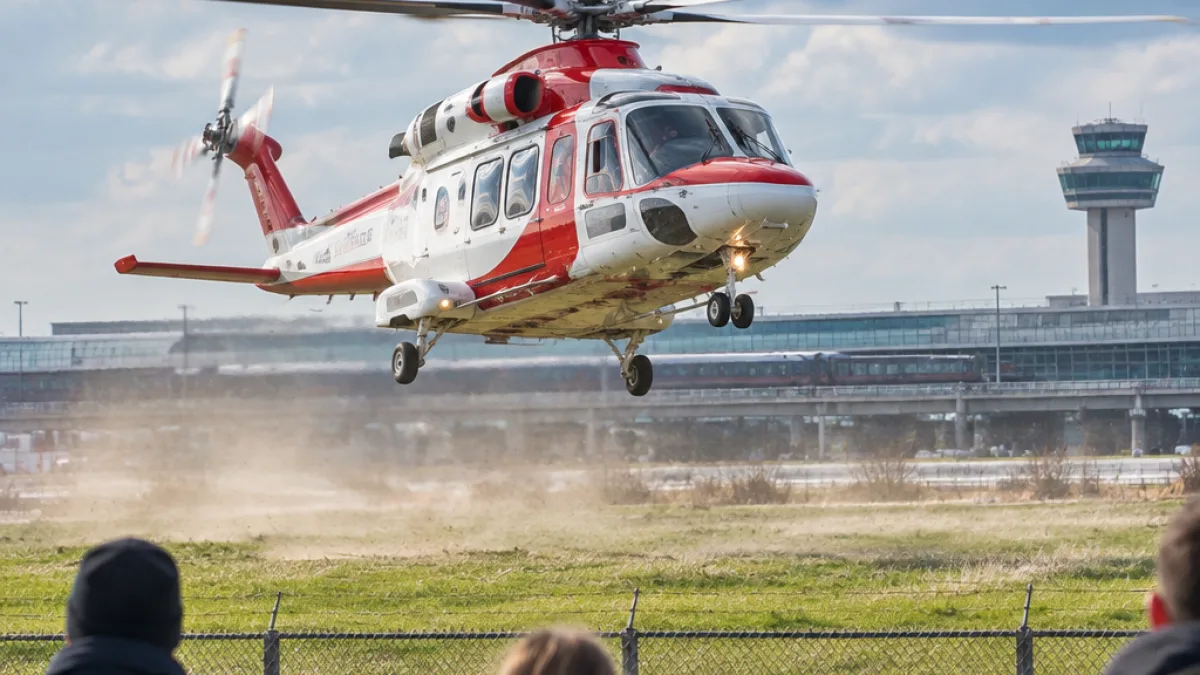
The incident occurred on 28 February 2026, after a Leonardo AW169 registered G-HHEM arrived in a field near Southend Airport railway station. The helicopter had been dispatched from North Weald Airfield in Essex to support a medical emergency in a residential area east of London Southend Airport.
Helicopter was leaving after medical response
Two paramedics left the aircraft after it landed, allowing them to attend to a patient. Before the helicopter departed, its commander saw several people near a roadside fence, including children, and told them to move to the other side of the road for their safety.
The woman who was later injured lived across the road and had not yet come outside when that warning was given. After hearing the helicopter’s engines start, she went onto her driveway to record the departure. She stood close to a parked car at a distance of approximately 30 metres from the aircraft.
The helicopter began an almost vertical climb at approximately 5.46pm local time. It initially climbed towards a height of about 200 feet. Roughly 50 seconds later, the downwash reached the woman’s position and knocked her to the ground. A relative went to assist her, and she was taken to hospital. The crew continued the flight without knowing that somebody had been injured.
AAIB records aircraft movement and airflow conditions
The AAIB found that the helicopter had drifted towards the road during its climb. Investigators also examined the wind conditions present at the time. The report identifies the interaction between the aircraft’s movement, the surrounding area and the airflow generated by the rotors as part of the circumstances in which the woman was knocked over.
The operator was told about the injury four days after the occurrence. The sequence described by the AAIB underlines the limits of relying only on warnings delivered to people already visible to a helicopter crew: the injured woman was inside her home when the commander spoke to the group by the roadside.
- The helicopter was a Leonardo AW169 registered G-HHEM.
- It had flown from North Weald Airfield to a field near Southend Airport to support a medical emergency.
- The woman was approximately 30 metres from the aircraft when the downwash struck her.
- The operator learned about the injury four days after the incident.
The report concerns a departure following an emergency medical response rather than an accident involving a loss of control or a crash. Its findings document the risk posed by rotor downwash beyond the immediate landing area, particularly when people are close to roads, homes and other public spaces during helicopter operations.