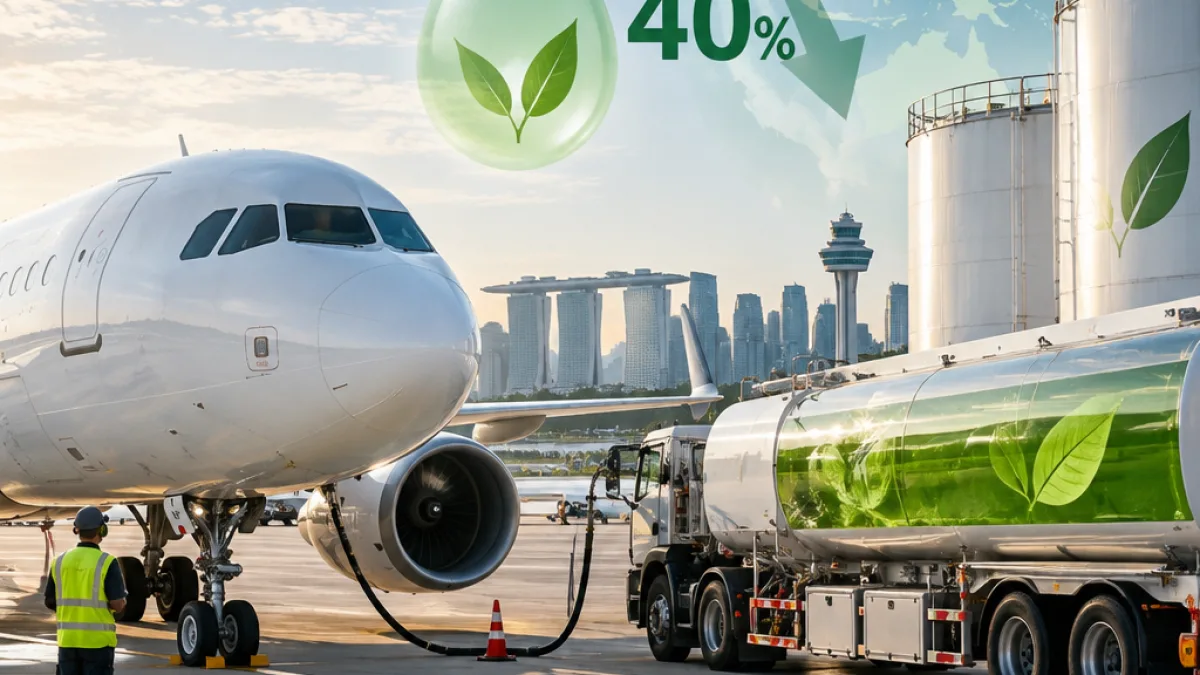
Singapore will purchase only sustainable aviation fuel (SAF) delivering at least a 40% reduction in lifecycle emissions compared with conventional jet fuel, under new requirements announced on 5 November 2026.
The threshold will apply to fuel purchased for Singapore’s aviation system and is intended to ensure that increasing SAF use produces a measurable emissions benefit. Daniel Ng, chief sustainability officer at the Civil Aviation Authority of Singapore (CAAS), described the requirement as a “modest starting point”, while saying it would provide a clear signal to the market.
Daniel Ng told The Straits Times that the 40% requirement is above the minimum reduction level of 10% under the Carbon Offsetting and Reduction Scheme for International Aviation (CORSIA). The fuel must also qualify under CORSIA, the global framework established by the International Civil Aviation Organization to address aviation carbon emissions.
First tender planned for December
The requirements have been shared with 15 potential suppliers and producers ahead of Singapore’s first tender. Singapore Sustainable Aviation Fuel Company (SAFCo), which is wholly owned by CAAS and has been established to purchase and manage SAF for the country’s air hub, plans to issue the tender by mid-December.
Deliveries of the fuel in blended form are scheduled to begin from June 2027. Singapore is targeting SAF to account for 1% of all jet fuel used at Changi and Seletar airports in 2027, increasing to between 3% and 5% by 2030.
| Target or measure | Details |
|---|---|
| Minimum lifecycle emissions reduction | 40% compared with traditional jet fuel |
| First SAF tender | Planned by mid-December |
| Blended fuel deliveries | From June 2027 |
| SAF use in 2027 | 1% of jet fuel at Changi and Seletar |
| SAF use by 2030 | 3% to 5% |
Passenger levy to support adoption
Singapore will introduce a green jet fuel levy from 1 January 2027. It will apply to passengers departing Singapore on tickets purchased from 1 October 2026, with the amount varying according to cabin class.
- Economy and premium economy passengers will pay between $1 and $10.40.
- Business and first-class passengers will pay between $4 and $41.60.
The levy is intended to support airlines’ use of SAF as Singapore begins increasing the share of alternative fuel supplied through its airports. SAF is generally produced from waste materials such as used cooking oil, but remains considerably more expensive than conventional jet fuel, creating a cost barrier to wider adoption.
By setting a threshold above the CORSIA minimum and linking procurement with a tender and passenger levy, Singapore is establishing requirements for both the environmental performance and financing of SAF used at its airports. The policy covers the country’s stated near-term objective of reaching 1% use in 2027, before the higher 2030 target.