The Aircraft Accident Investigation Bureau (AAIB) has attributed a serious runway incursion at Dabolim Airport to failures in cockpit communication and compliance with air traffic control instructions. The incident involved Air India Express flight AXB-1109, a Boeing 737-8 operating from Dabolim to Delhi, and an Indian Navy fighter aircraft departing from the same runway.
The event occurred on 3 April, when the civil aircraft was taxiing after its planned runway had changed from Runway 26 to Runway 08. The crew was told to expect a backtrack, then instructed by the surface movement controller to taxi via taxiway N2 and stop at the Runway 08 holding point. The AAIB found that the pilot flying understood the earlier “expect backtrack” transmission as permission to enter and backtrack on the runway.
Instructions were not fully acknowledged
The crew acknowledged the taxi routing but did not repeat, or act on, the requirement to hold at the designated point. The surface movement controller also did not require a complete readback, meaning the missed holding instruction was not detected before the aircraft continued towards the active runway.
The AAIB identified a second probable cause in the crew’s failure to establish communication with Navy Approach on 119.7 MHz before entering the runway. Air traffic services at Dabolim’s civil enclave are provided by INS HANSA: surface movement control is handled by the Airports Authority of India, while tower and approach control are provided by the Indian Navy.
“Had they stopped and established positive communication with the Navy-ATC before entering the active runway, the incident could have been avoided,” the AAIB said.
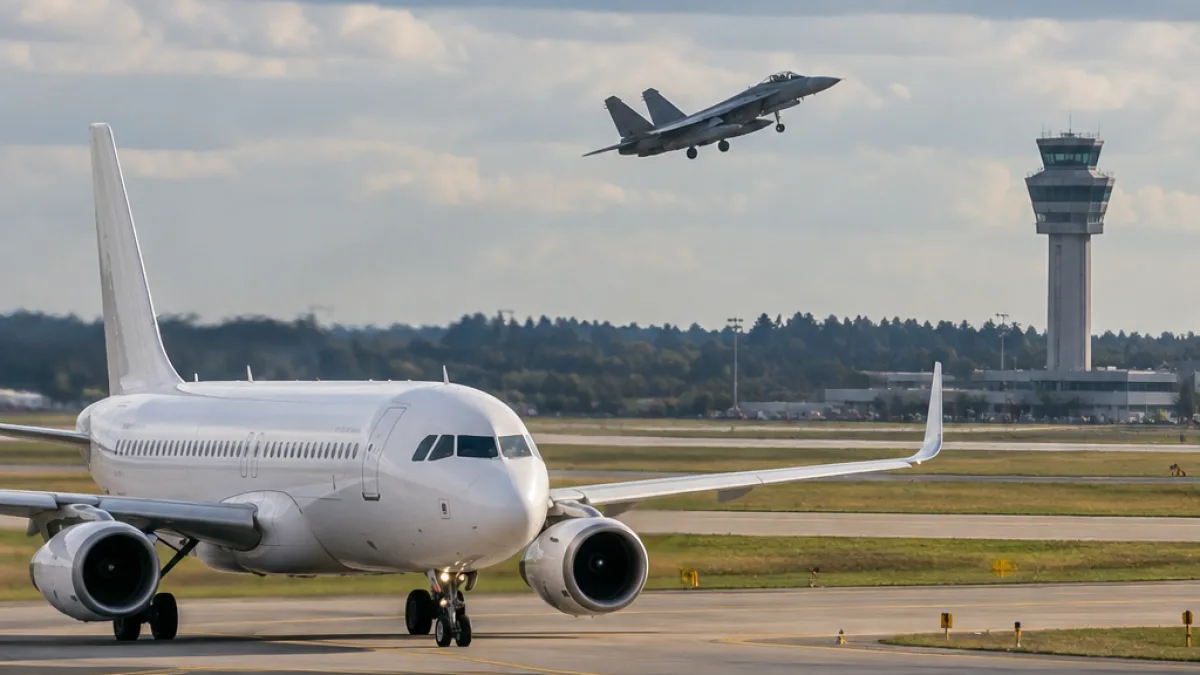
By the time the unauthorised runway entry was detected, the Navy aircraft had received take-off clearance and had begun its take-off roll on Runway 08. The tower controller alerted the departing pilot, describing the civil aircraft as unidentified on the runway. The fighter accelerated its departure and became airborne approximately 2,000 metres from the runway’s starting point.
The investigation recorded an estimated separation of about 900-1,000 metres between the fighter’s lift-off point and the Air India Express aircraft. The fighter subsequently reached approximately 450 feet above the runway near taxiway N3. There were 171 people on board the Air India Express flight and no injuries were reported.
Distraction and airport risk factors
In addition to the two probable causes, the AAIB identified factors that affected the crew’s performance during the event. These included the trainee first officer’s attention being diverted to pre-take-off calculations after the runway change, together with insufficient monitoring of radio communications.
The final report also recommends further training for Air India Express crews. Separately, it says taxiway N2 should be considered a hotspot because of its proximity to Bays 1 and 2 on the civil apron and the increased possibility of ground collisions and runway incursions.
- Flight: Air India Express AXB-1109 from Dabolim to Delhi
- Aircraft: Boeing 737-8
- Safety event: Unauthorised entry to Runway 08 while an Indian Navy fighter was taking off
- Outcome: No injuries reported among the 171 people on the civil aircraft
The report places responsibility for preventing a recurrence across both flight operations and air traffic control. For the crew, the findings emphasise the need to distinguish an expectation from an explicit runway clearance, comply with a hold instruction and establish the required two-way communication before proceeding. For ground control, the investigation highlights the importance of obtaining a complete readback when issuing instructions intended to keep an aircraft away from an active runway.