
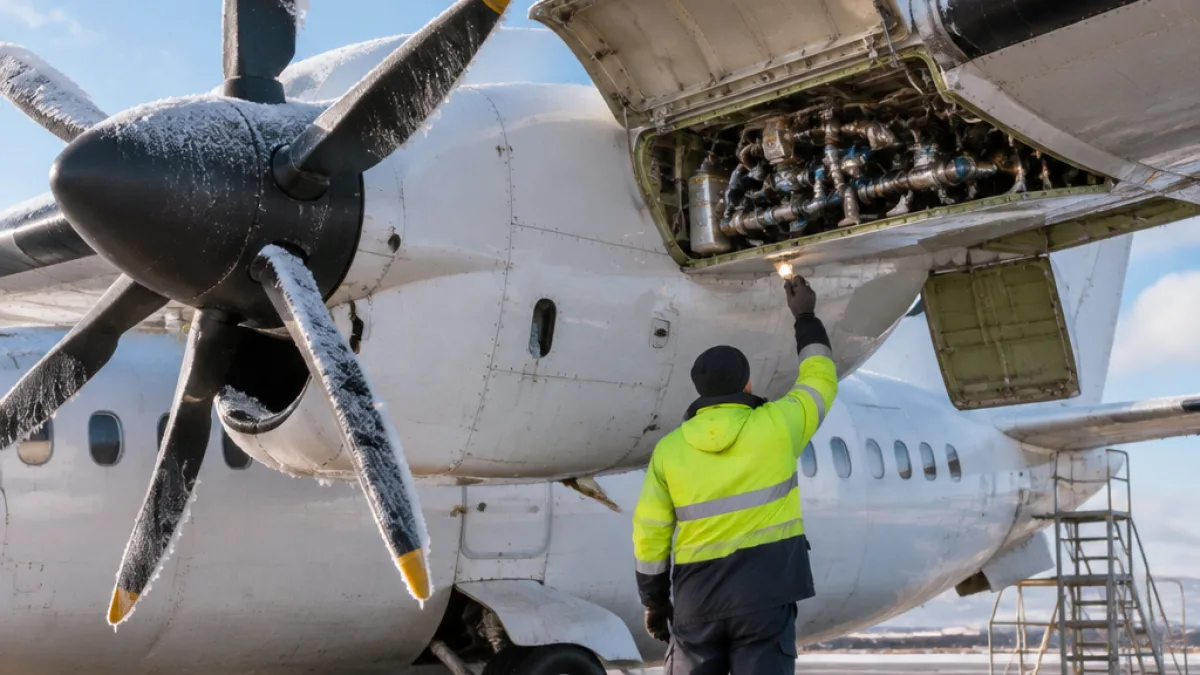
European Union Aviation Safety Agency (EASA) has ordered operators of ATR 42 and ATR 72 turboprops to carry out more frequent inspections of valves in their de-icing systems, warning that a failure could remain undetected until an aircraft encounters icing conditions and result in an unrecoverable loss of control.
The airworthiness directive was issued on 16 November 2026 and will take effect on 30 November. It follows further analysis of potential valve failure modes and revised maintenance instructions issued by ATR in October. EASA had already reduced the inspection intervals in January 2025 after a design review identified a risk involving the system.
Inspection intervals vary by aircraft configuration
The directive covers valves responsible for regulating pressure and shutting off the air supply to the aircraft’s de-icing system. The required inspection frequency depends on the aircraft model and on whether the relevant modification was completed by ATR during production or subsequently carried out by an operator.
| Aircraft | Previous interval | New interval |
|---|---|---|
| Modified ATR 42-400, ATR 42-500 and ATR 72 | 1,050 flight hours | 160 flight hours |
| Unmodified ATR 42-400, ATR 42-500 and ATR 72 | 700 flight hours | 210 flight hours |
| ATR 42-200, ATR 42-300 and ATR 42-320 | 650 flight hours | 190 flight hours |
The largest reduction applies to modified ATR 42-400s, ATR 42-500s and ATR 72s. Their permitted interval falls by 85%, from 1,050 flight hours under the January 2025 directive to 160 flight hours under the latest order. For aircraft of the same models without the modification, the interval falls from 700 to 210 flight hours.
Action required where a valve fails
Operators must correct any fault identified during an inspection before the aircraft is returned to service. Where ATR’s published maintenance instructions do not cover the specific defect, the operator must obtain approved instructions from the manufacturer and complete the required work.
The latest action follows information identified during the investigation into the crash of Voepass Flight 2283 in Brazil. Brazilian investigators identified ice accumulation and several de-icing system failures among the factors that contributed to the accident on 9 August 2024. All 62 people on board the ATR 72-500 died when it crashed in Vinhedo.
ATR issued its first notice to operators concerning the valve inspections in October 2024, approximately two months after the accident. EASA’s new directive now formalises the revised requirements and sets the inspection intervals that affected operators must meet from 30 November.
- The directive applies to ATR 42 and ATR 72 turboprops.
- The shortest inspection interval is 160 flight hours for specified modified aircraft.
- Faults must be rectified before an aircraft flies again.