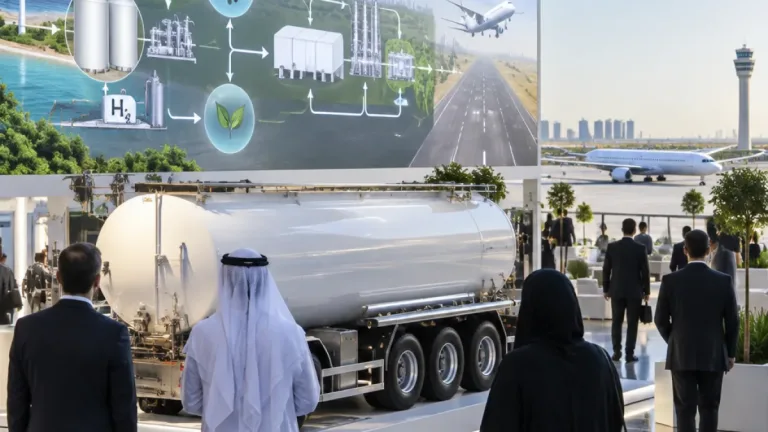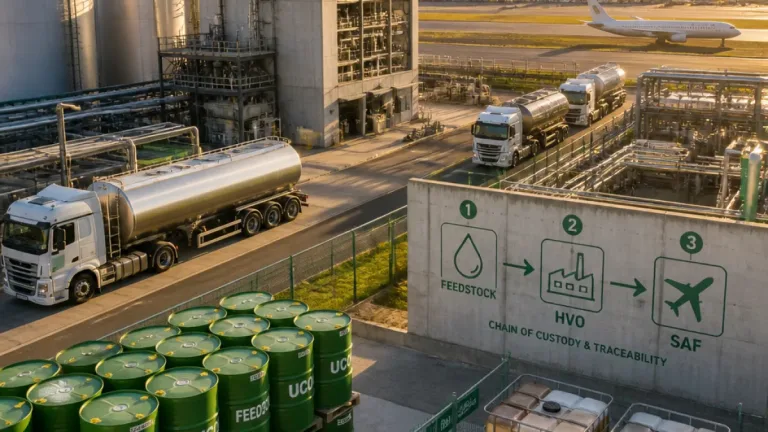
Global sustainable aviation fuel (SAF) production is expected to reach approximately 2.4 million tonnes in 2026, according to IATA, but that volume will account for only 0.8% of total aviation fuel use. The figures highlight the gap between the industry’s ambitions for lower-carbon fuel and the output currently available to airlines.
IATA estimates that airlines will spend $4.3 billion on SAF in 2026. However, production facilities are operating well below their potential output, leaving a substantial difference between installed capacity and the quantity of fuel actually being made.
E-SAF pipeline remains particularly limited
The shortfall is most pronounced in electricity-based sustainable aviation fuel. IATA puts worldwide e-SAF capacity, including facilities that are operational or under construction, at approximately 0.02 million tonnes. Only one facility is currently producing e-SAF anywhere in the world, while no new final investment decision for an e-SAF plant has been recorded during the past 12 months.
e-SAF is the segment on which regulators have placed significant emphasis. The fuel is intended to support longer-term decarbonisation goals, but the present production base remains far below the scale implied by the targets set in Europe.
| Measure | 2026 figure or requirement |
|---|---|
| Global SAF production | Approximately 2.4 million tonnes |
| Share of aviation fuel use | 0.8% |
| Airline SAF spending | $4.3 billion |
| Global e-SAF capacity | Approximately 0.02 million tonnes |
| EU and UK e-SAF production mandate for 2030 | Approximately 0.6 million tonnes |
Mandates create a large construction requirement
The EU and UK have set an e-SAF production mandate of approximately 0.6 million tonnes by 2030, IATA calculates. Reaching that level would require roughly 20 commercial-scale refineries to be built and operating, according to the association.
The comparison between the mandate and current capacity underlines the challenge facing airlines, fuel suppliers, airports and project developers. Production is not simply constrained by demand: facilities already counted in the industry’s capacity figures are not delivering fuel at full output, while the e-SAF investment pipeline has yet to produce a new final investment decision in the period tracked by IATA.
ReFuelEU data updated
The European Union Aviation Safety Agency (EASA) has published its ReFuelEU Aviation Annual Technical Report 2026, based on data from 2025. That was the first year in which the core obligations of the ReFuelEU Aviation Regulation came into force.
EASA issued a corrigendum on 2 November 2026 to clarify figures concerning SAF production and imports. The amendment does not change the report’s findings on SAF volumes supplied at Union airports in 2025, or any other key performance indicator included in the report.
- SAF production is rising, but remains a small proportion of aviation fuel demand.
- e-SAF capacity is measured in hundredths of a million tonnes and is currently concentrated in a single producing facility.
- Meeting the EU and UK’s 2030 e-SAF mandate would require a major expansion of commercial-scale refinery capacity.