The UK Civil Aviation Authority (CAA) has issued a lithium-battery safety checklist for air passengers, warning that incidents involving rechargeable devices remain a significant risk during the busy October half-term period.
The regulator said an increasing number of passengers are travelling with phones, tablets, laptops, vapes and power banks. It has also reported instances in which UK flights were delayed because potentially dangerous items had to be removed from baggage before departure.
The CAA expects three million passengers to travel across England and Wales during the October half-term. Passengers are carrying an average of four lithium-powered devices each, while the proportion taking a power bank on a flight has risen to 54%, from 49% last year.
Cabin carriage required for power banks
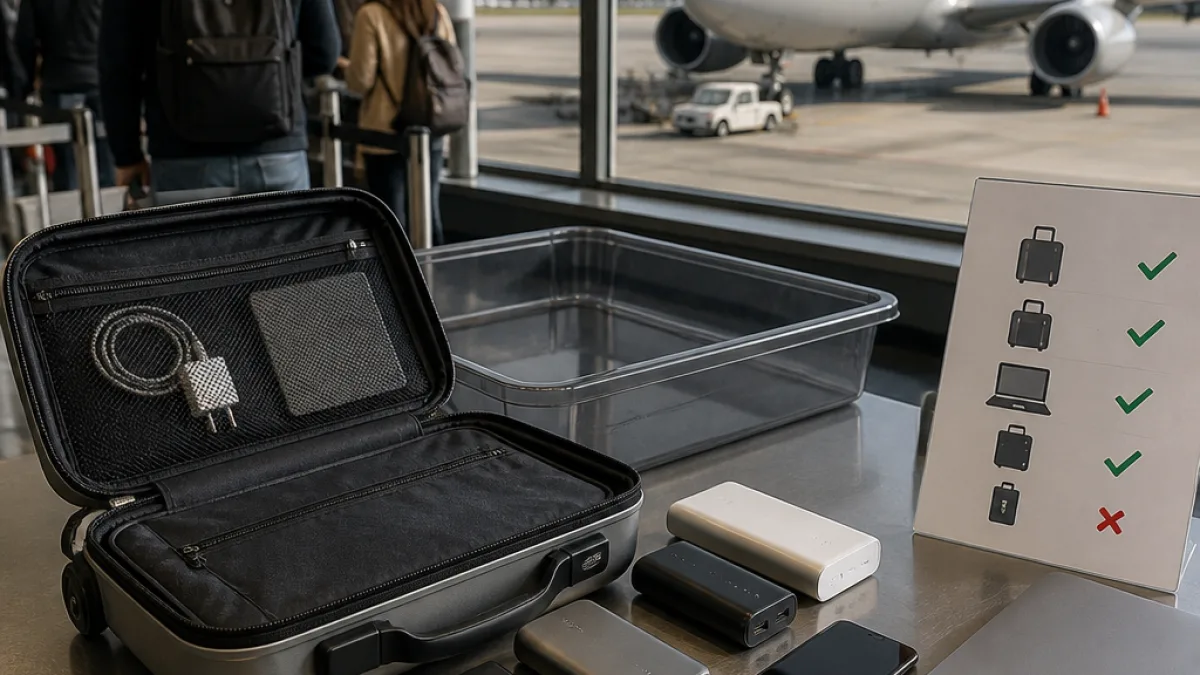
Power banks must not be packed in checked-in luggage placed in the aircraft hold, according to the CAA. They should instead be carried in the cabin, where cabin crew can respond more quickly if a device begins to overheat.
The regulator’s guidance also covers what passengers should do before and during a flight:
- Carry power banks in the cabin and check with the airline that they comply with its limits on size and quantity.
- Do not charge a power bank during a flight.
- Ask cabin crew before using a power bank on board and keep it within sight while it is being used.
- If a power bank, vape, phone or tablet becomes hot, switch it off, stop charging it and alert cabin crew immediately.
The CAA’s warning places responsibility on passengers to identify signs of overheating and to report them promptly. Devices carried in the cabin remain accessible to crew, unlike items stowed in the hold, where an overheating battery may be harder to detect and deal with before it creates an operational problem.
Potential impact on flight operations
The regulator said incorrectly packed electrical gadgets, particularly vapes and power banks, can result in baggage being offloaded. Removing such items has already caused delays to UK flights, linking battery-safety compliance directly to departure operations as well as passenger safety.
The volume of devices being carried is adding to the scale of the issue. With millions of rechargeable gadgets travelling by air each day and more than half of passengers now carrying a power bank, the CAA is seeking to make the correct carriage and handling of lithium-battery equipment part of normal pre-flight preparation.
The checklist does not replace individual airline rules. Passengers are instructed to confirm that their power banks meet the relevant carrier’s limits on size and quantity, while seeking cabin-crew approval before using one during the flight. The CAA’s advice is intended to reduce the likelihood of overheating incidents and the resulting need for intervention, baggage removal or delays.