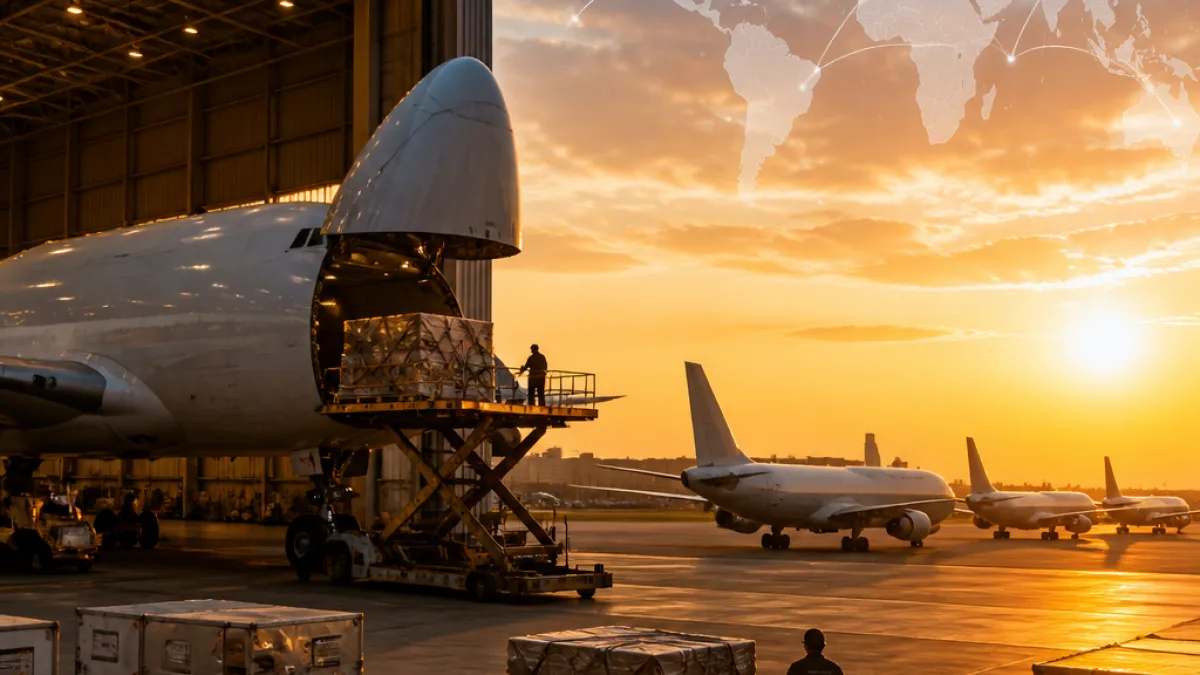
Airbus projects a 46% expansion of the global dedicated freighter fleet over the next two decades, forecasting growth from 2,360 aircraft in 2026 to 3,460 by 2045. The manufacturer published the figures in its 2026 Cargo Global Market Forecast, presented at the Cargo Facts Symposium in Nashville.
Deliveries, replacements and conversions
Airbus says the market will require 2,670 freighter deliveries between 2026 and 2045. That demand is split between replacement of ageing types and additional capacity to serve rising traffic, with the company quantifying the breakdown:
- 1,580 aircraft to replace older freighters
- 1,090 aircraft to meet growth in cargo demand
The forecast expects 1,700 of those deliveries to come from passenger-to-freighter conversions and 970 from new-build freighters. By size category, Airbus identifies demand for 1,140 single-aisle freighters, 860 medium widebodies and 670 large widebodies.
Regional split and traffic growth
Regionally, Airbus puts North America at the top of freighter demand with 925 deliveries, followed by Asia-Pacific on 850 deliveries. Together these two regions account for around two-thirds of the total requirement. The forecast lists the remainder as Europe and the CIS 515, Latin America 165, the Middle East 125 and Africa 90.
Airbus also projects annual air cargo traffic growth of 3.2% over the next two decades, slightly outpacing its projection for global trade at 2.9%. The manufacturer highlights e-commerce, shipments of high-value technology goods and a shift to air freight as an alternative to maritime transport among the principal demand drivers.
Implications for fleets, converters and manufacturers
The forecast identifies opportunities for Airbus’s freighter products and for the conversion market. Airbus specifically points to demand for conversions across the A320, A321 and A330 families and expects operators to consider the A350F among new-build options. The split between conversions and new-builds suggests a sustained role for passenger-to-freighter programmes through the period covered by the forecast.
| Metric | Value |
|---|---|
| Freighter fleet (2026) | 2,360 aircraft |
| Freighter fleet (2045) | 3,460 aircraft |
| Required deliveries (2026–2045) | 2,670 |
| Conversions | 1,700 |
| New-build freighters | 970 |
The forecast’s emphasis on single-aisle freighters — a requirement of 1,140 aircraft — underlines the growing role of narrowbody freighters for short-to-medium haul and express e-commerce routes. Demand for 860 medium and 670 large widebodies also signals continued need for higher-capacity long-haul freighters.
For air cargo operators, lessors and conversion houses, Airbus’s numbers frame a substantial market for both conversion programmes and new freighter programmes. The forecast’s regional breakdown reaffirms the strategic importance of North America and Asia-Pacific to freighter demand over the next two decades.