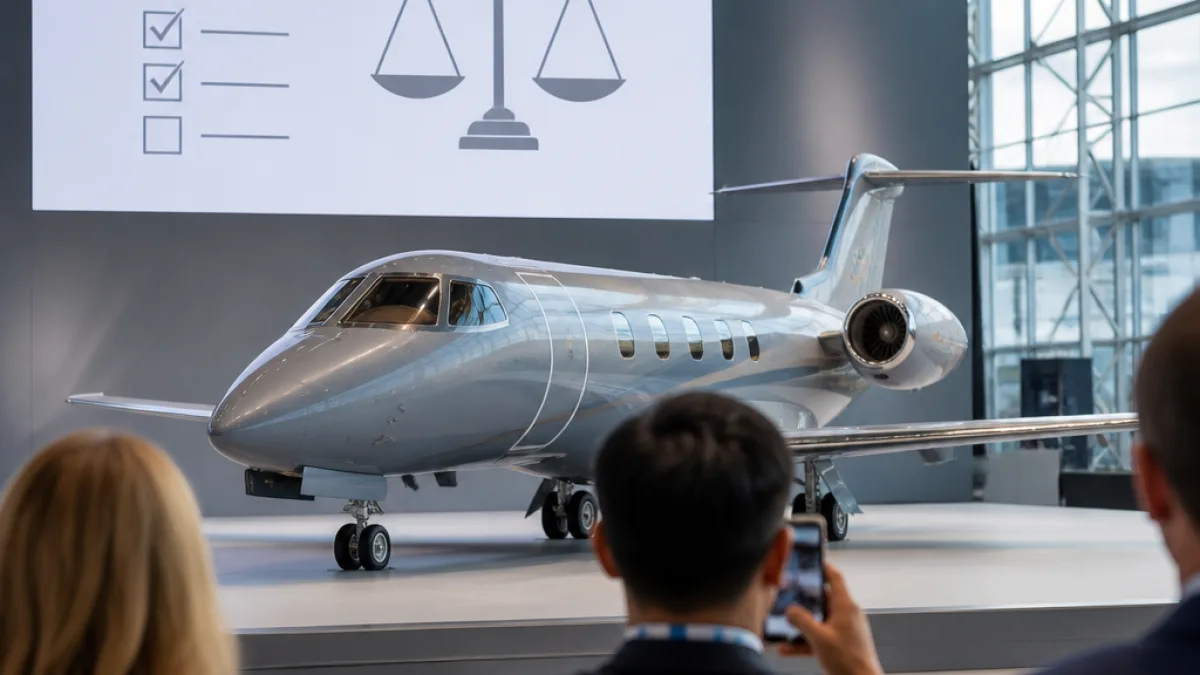
The Federal Aviation Administration (FAA) has signalled it is willing to re-examine permitting single-pilot operation in certain legacy Cessna Citation jets, provided changes can achieve an equivalent level of safety to two-pilot crewing. The comments were made by FAA Administrator Bryan Bedford at the NBAA Business Aviation Convention & Exhibition.
Agency seeks safety parity before any exemption
Administrator Bedford said the FAA rescinded a prior single-pilot exemption for some legacy Cessna Citation models after reviewing training compliance concerns and accident data. The agency found that aircraft operating under the previous exemptions had an accident rate “more than twice” that of comparable two-pilot operations.
“In order to achieve any exemption, the FAA asks one question: Can we find an alternative that will give us an equivalent level of safety? If we can't get to at least an equivalent level of safety, we shouldn't be entertaining it.” — Bryan Bedford, FAA Administrator
The rescission followed the FAA’s review of both procedural compliance and safety performance. At NBAA-BACE, the FAA was asked about the prospect of restoring single-pilot operations if additional training and Supplemental Type Certificate (STC) modifications could remove observed safety gaps; Bedford said those measures are “worthy of scrutiny.”
What the FAA said and why it matters
According to the FAA's public remarks, the central test for any future exemption will be whether an alternative combination of pilot training and aircraft modification can demonstrably match the safety record of two-pilot operations. The statement ties the agency’s openness to objective evidence on accident rates and training compliance rather than a policy push to broaden single-pilot privileges.
- FAA rescinded a single-pilot exemption for some legacy Cessna Citation jets after reviewing training compliance and accident data.
- The cited accident rate for aircraft operating under the exemption was more than twice that of comparable two-pilot operations.
- The FAA said it would consider additional training and STC modifications if they deliver an equivalent level of safety.
The issue has particular resonance for the business-aviation community, which has a longstanding interest in single-pilot operations for cost and crewing flexibility. Any future change would involve the FAA assessing training programmes, possible cockpit changes through STCs, and the safety data produced by such measures.
Industry questions and next steps
At the NBAA event, the FAA’s position framed further work as an evidence-driven process. The agency will require concrete proposals demonstrating that changes to training standards and aircraft systems could close the safety gap identified in the accident data. The FAA’s remark that the possibility is “worthy of scrutiny” indicates openness to submissions, but not a commitment to reinstate exemptions.
| Issue | FAA position (from remarks) |
|---|---|
| Rescinded single-pilot exemption | Removed following review of training compliance and accident data |
| Accident rate comparison | More than twice the rate for exempted operations versus comparable two-pilot operations |
| Conditions for reconsideration | Additional training and STC modifications that achieve equivalent safety |
Any formal avenue to restore exemptions would require operators, manufacturers or modifiers to present detailed training curricula, modification programmes and safety analyses for FAA review. The agency’s insistence on ‘‘equivalent level of safety’’ underlines that future decisions will rest on measurable, documented outcomes.
The FAA’s comments at NBAA-BACE underline the regulator’s data-driven approach to exemptions affecting crew requirements and will be closely watched by business-aviation operators, maintenance and modification firms, training organisations and insurers contemplating the implications of any regulatory change.