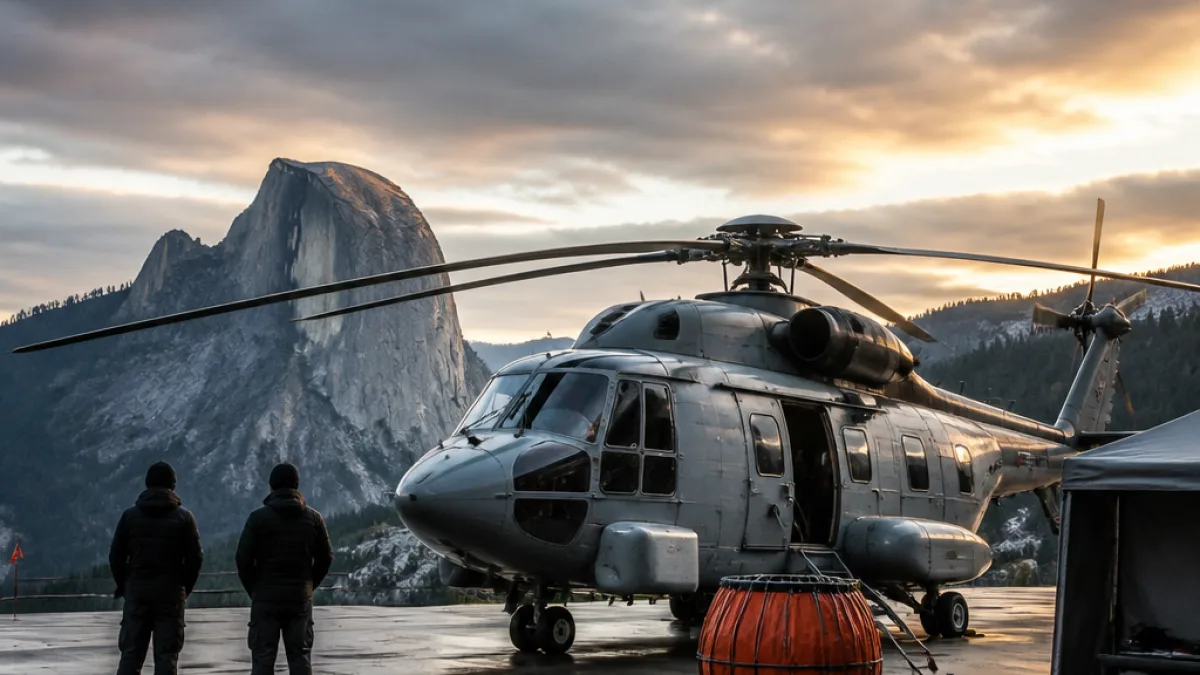
The National Transportation Safety Board (NTSB) has released a preliminary account of events leading to the helicopter accident in Yosemite National Park on 20 September that killed both pilots aboard a contracted firefighting aircraft.
Flight operations and sequence
The aircraft involved was a Eurocopter AS32 Super Puma operated on contract for firefighting. According to the NTSB, the helicopter had been airborne for nearly three hours and completed more than 25 water drops before the accident. Both pilots — Ryan Cutter of Utah and Greg King of Alaska — were fatally injured.
Investigators report the crew experienced problems with the helicopter’s 800-gallon water bucket during operations. At one point the aircraft returned to the helibase so mechanics could tighten the bucket’s air pressure regulator and conduct a pressure check. The NTSB account states the crew then resumed firefighting after the maintenance activity.
Final missions documented
Using flight data and cellphone video recorded from the ground, NTSB investigators established that the helicopter made two further water drops following the helibase visit. It subsequently returned to the lake for a third pickup and crashed after completing the third run from Ostrander Lake.
Imagery examined by investigators showed the bucket behaviour varied between drops. The report notes the first of the documented drops proceeded with the bucket remaining above the tree canopy. During the second documented drop, the NTSB says the water release caused the helicopter to swerve to the left. On the third pickup, video screenshots revealed the bucket descending vertically while water was still discharging from its underside before it struck the ground. The NTSB states the cargo hook was released, allowing the line to fall.
“Something doesn't fail until it fails. I don't see any evidence here in just the beginnings in this investigaiton that they should not have gone back on that final run based on what they knew. I don't think experienced pilots like this would have hesitated to keep it on the ground,”
The preceding quotation is from ABC News aviation analyst John Nance, who reviewed the NTSB preliminary report.
Investigation status and context
The NTSB material published so far is preliminary. It documents the recorded flight path, the sequence of water drops and the maintenance activity on the bucket air pressure regulator that occurred before the final sorties. The board’s factual findings in a preliminary report do not determine probable cause; the formal investigation process will progress through further analysis of systems, maintenance records, operational procedures and other available evidence.
- Aircraft type: Eurocopter AS32 Super Puma
- Date of accident: 20 September
- Crew: two pilots (Ryan Cutter; Greg King) — both killed
- Operational detail: nearly three hours airborne and more than 25 water drops before the accident
- Equipment noted: 800-gallon water bucket; air pressure regulator work completed at helibase
The NTSB’s preliminary account provides a timeline and factual observations that will form the basis for further technical analysis. The board will continue its inquiry and issue subsequent reports as its work advances.
| Item | Detail |
|---|---|
| Aircraft | Eurocopter AS32 Super Puma |
| Operation | Contracted aerial firefighting |
| Date | 20 September |
| Crew | Ryan Cutter; Greg King (both killed) |
| Noted issue | Bucket air pressure regulator tightened at helibase; subsequent drops recorded |