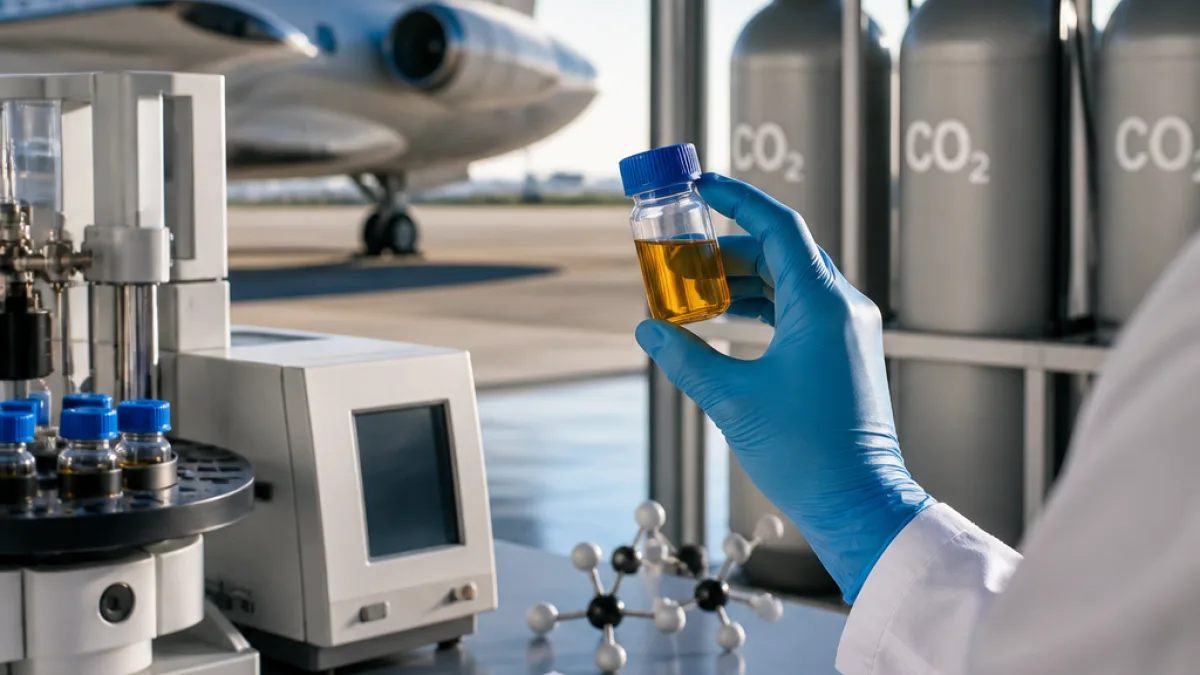
OXCCU has produced samples of a finished synthetic blend component for sustainable aviation fuel and had the material tested to international standards by Intertek, the company announced. Intertek’s analysis, OXCCU said, shows the product meets ASTM D7566 Annex A4 specifications for Fischer-Tropsch Synthesised Kerosine with Aromatics (FT-SPK/A), an internationally recognised synthetic blending component specification.
What was validated and why it matters
According to OXCCU, the test results demonstrate that the physical and chemical properties of its product align with those required for FT-SPK/A. The company uses a proprietary iron Fischer-Tropsch catalyst and a one-step CO₂-to-fuel process to produce the four hydrocarbon classes present in jet fuel: paraffins, isoparaffins, cycloparaffins and aromatics. OXCCU said this composition allows a genuinely drop-in SAF.
“We have demonstrated our ability to make all four of the components which make up jet fuel using OXCCU’s iron FT technology: paraffins, isoparaffins, cycloparaffins and aromatics. This means it is a truly drop-in sustainable aviation fuel. Other technologies such as cobalt FT or methanol to jet will only make two of the components, paraffins and isoparaffins. This milestone strengthens confidence in our SAF product.” — Andrew Symes, CEO of OXCCU
Intertek’s commentary, quoted by OXCCU, highlighted blending limitations encountered by paraffinic SAF pathways and the potential role of FT-SPK/A to provide properties closer to conventional Jet A/A-1. Liam Mills, Sustainable Hydrocarbon Specialist at Intertek, said FT-SPK/A can support higher SAF utilisation where paraffinic blends face constraints.
“Current paraffinic SAF pathways face blending limitations because key fuel properties can fall outside specification. While 50% HEFA-SPK blends are achievable using conventional fuels with favourable properties, future blending will likely involve a broader range of jet fuels, reducing blending flexibility. FT/SPK-A offers properties closer to conventional aviation fuel, providing an alternative pathway that can support higher overall SAF utilisation where paraffinic blends are constrained.” — Liam Mills, Sustainable Hydrocarbon Specialist, Intertek
Next steps and claims
OXCCU said further testing and optimisation continue, while describing the Intertek validation as an early but significant step towards commercialisation. The company also stated that its process has the potential to produce a 100% drop-in SAF blendstock and to materially reduce capital and operating costs compared with more complex multi-step routes.
- Technology: one-step CO₂-to-fuel using iron FT catalyst
- Specification validated: ASTM D7566 Annex A4 (FT-SPK/A)
- Independent tester: Intertek
| item | detail |
|---|---|
| Company | OXCCU |
| Independent tester | Intertek |
| Specification | ASTM D7566 Annex A4 (FT-SPK/A) |
| Product claim | 100% drop-in SAF blendstock potential |
The validation strengthens the case for FT-SPK/A as an alternative to paraffinic SAF routes such as HEFA-SPK or methanol-to-jet, which OXCCU said produce fewer of the hydrocarbon classes present in conventional jet fuel. OXCCU and Intertek both framed the result as a step towards broader SAF utilisation by addressing blending constraints.
OXCCU emphasised that although the Intertek test demonstrates compliance with Annex A4 properties, further work remains to optimise production and to scale the process to commercial levels. The company did not publish production capacity estimates, timelines for commercial operations or details of financing in the Intertek statement.
For airline and airport sustainability planners, the verification represents a technology milestone rather than an immediate new source of certified SAF volumes; it provides a technical validation that could be relevant as projects based on CO₂-to-fuel chemistry move from pilot scale towards commercial deployment.