
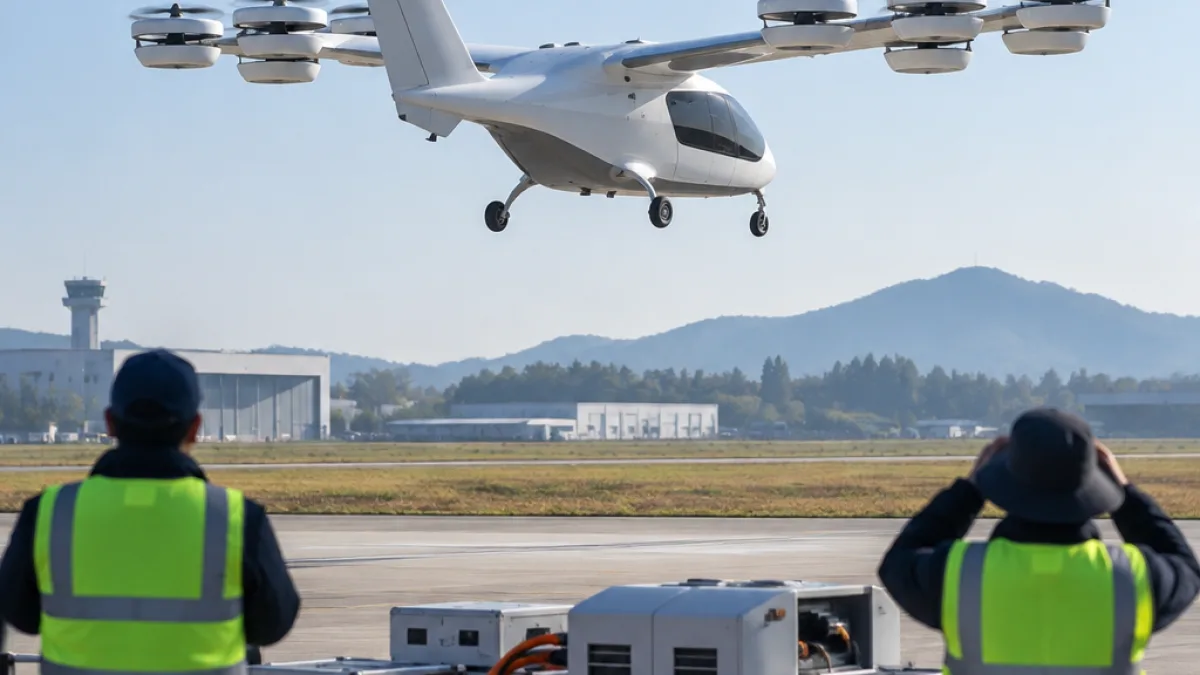
China has completed the first piloted flight of a 19-seat electric passenger aircraft, marking a further step in the development of battery-powered commercial aviation. The CE-25A, developed by the Commercial Aircraft Corporation of China (COMAC), carried out the test flight in Shandong province on 14 November 2026.
Test flight carried two pilots and an engineer
The aircraft flew 60.4 kilometres during a flight lasting 16 minutes and 38 seconds. Its crew comprised two pilots and a flight-test engineer. The flight was conducted as a piloted test rather than a passenger service, and forms part of the aircraft’s development programme.
The CE-25A is described as a 10-tonne aircraft with a cruising speed of 300 km/h and a stated range of 400 km. Propulsion is provided by 10 battery-powered ducted fans, distinguishing the aircraft from conventional passenger aircraft that rely on jet fuel or aviation turbine fuel.
| Aircraft | Capacity | Stated range | Test flight |
|---|---|---|---|
| COMAC CE-25A | 19 seats | 400 km | 60.4 km in 16 minutes 38 seconds |
Certification application accepted
China’s Civil Aviation Administration (CAAC) has accepted the CE-25A’s application for type certification. That acceptance places the programme within the formal process for assessing whether the aircraft meets the requirements needed for civil aviation operations.
The test is significant because battery-electric aircraft remain concentrated on relatively short-distance concepts, where the limitations of battery energy storage are less restrictive than on longer routes. The CE-25A’s development is therefore focused on a segment of air transport in which a smaller aircraft and a stated range of 400 km may be operationally relevant.
Electric propulsion remains an emerging technology
Electric aircraft use electric motors and battery systems instead of, or alongside, conventional aviation fuel. Their intended benefits include lower carbon emissions, reduced fuel consumption and less noise, although the technology continues to face challenges involving range, charging and flight safety.
- The CE-25A has 19 seats and a stated range of 400 km.
- The aircraft uses 10 battery-powered ducted fans.
- CAAC has accepted its application for type certification.
The aircraft’s first piloted flight does not itself represent certification or the start of commercial operations. It does, however, provide a flight-test milestone for COMAC as the manufacturer develops a battery-powered passenger aircraft and progresses through China’s civil aviation regulatory process.