
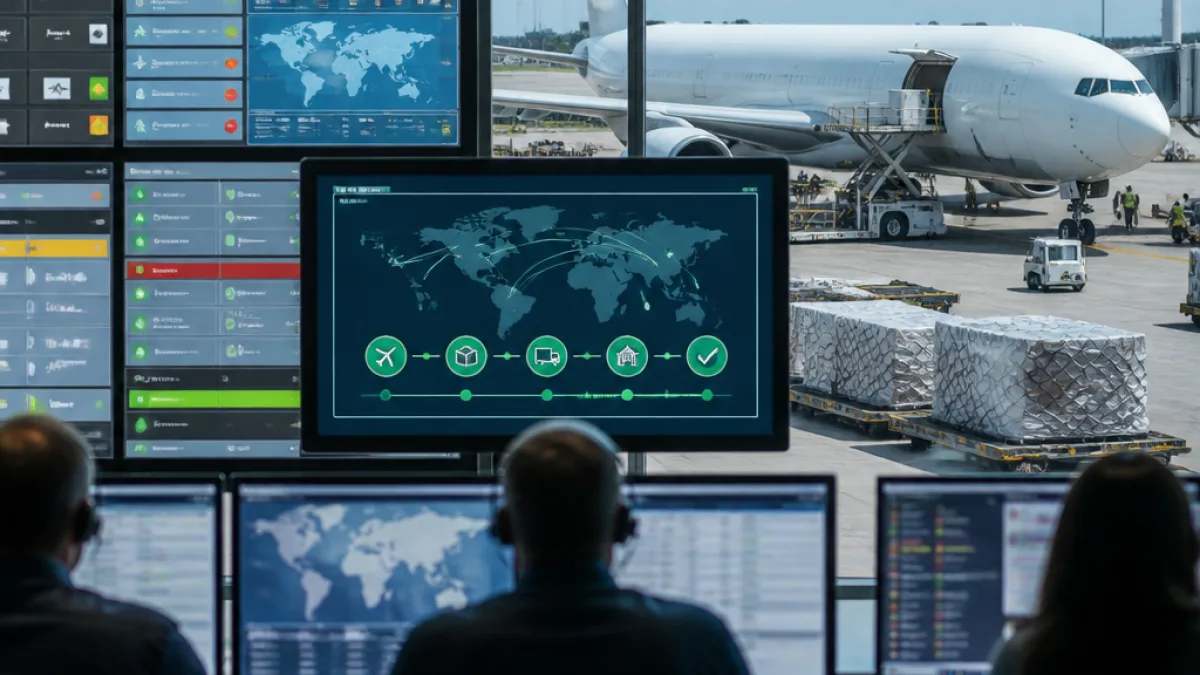
Fragmented airline messaging is constraining end-to-end visibility in airfreight, forcing forwarders into time-consuming manual checks and increasing operational cost, according to an analysis published by Air Cargo Week.
Visibility gap across export and import milestones
The analysis highlights that standard airline messaging commonly covers only 40–60% of key export milestones. That shortfall leaves forwarders to bridge significant information gaps by checking airline portals, requesting manual updates or entering data into their own systems.
Airfreight involves numerous participants — multiple airlines, ground handlers, agents and IT systems — each generating status updates or milestones for a single shipment. Where those milestones are not consistently transmitted to the parties that need them, decision-making slows and customer confidence erodes, the report says.
Automation improves coverage but challenges remain
Automated data integration is presented as a practical remedy. The report cites Riege Software’s Airline Messaging Premium as an example of how automation can materially increase visibility: in its customers’ systems, export milestone coverage rose to over 90%.
“Today we see that airline event data is often only partially available. Standard airline messaging typically covers around 40–60 percent of important export milestones,”
The quotation is attributed to Antonia Ambrozy, Director of Strategic Partnerships at Riege Software, in the Air Cargo Week piece.
However, the analysis stresses that the problem is not solely technical. A persistent asymmetry exists between export and import messaging: airlines tend not to send import milestone updates to the responsible import forwarder, instead routing them to the export agent. That practice results in limited visibility within import systems, and the largest gaps occur around events such as FOH (Freight on Hand at origin airport) and DLV (Delivered to/Picked up at destination airport).
- Standard messaging coverage: typically 40–60% of export milestones
- Automated integration effect: Riege’s Airline Messaging Premium increased export milestone coverage to over 90% in customer systems
- Biggest gaps: FOH and DLV events, and import-side updates routed to export agents
The report underlines that while the airfreight ecosystem is inherently interconnected, information flow remains fragmented. That fragmentation increases the amount of manual work for forwarders and can impair operational productivity and service reliability.
Air Cargo Week frames the solution as twofold: wider adoption of automated data exchange and changes to messaging practices that ensure import updates reach the responsible import forwarder. Both elements are presented as necessary to close visibility gaps and reduce the administrative burden on forwarders.
For commercial and operational managers, the analysis reinforces a simple market truth: improving milestone visibility reduces friction and the cost of moving goods by air. The industry examples cited signal that vendor solutions are available today, but systemic benefits require consistent implementation across airlines, GSAs, handlers and forwarders.