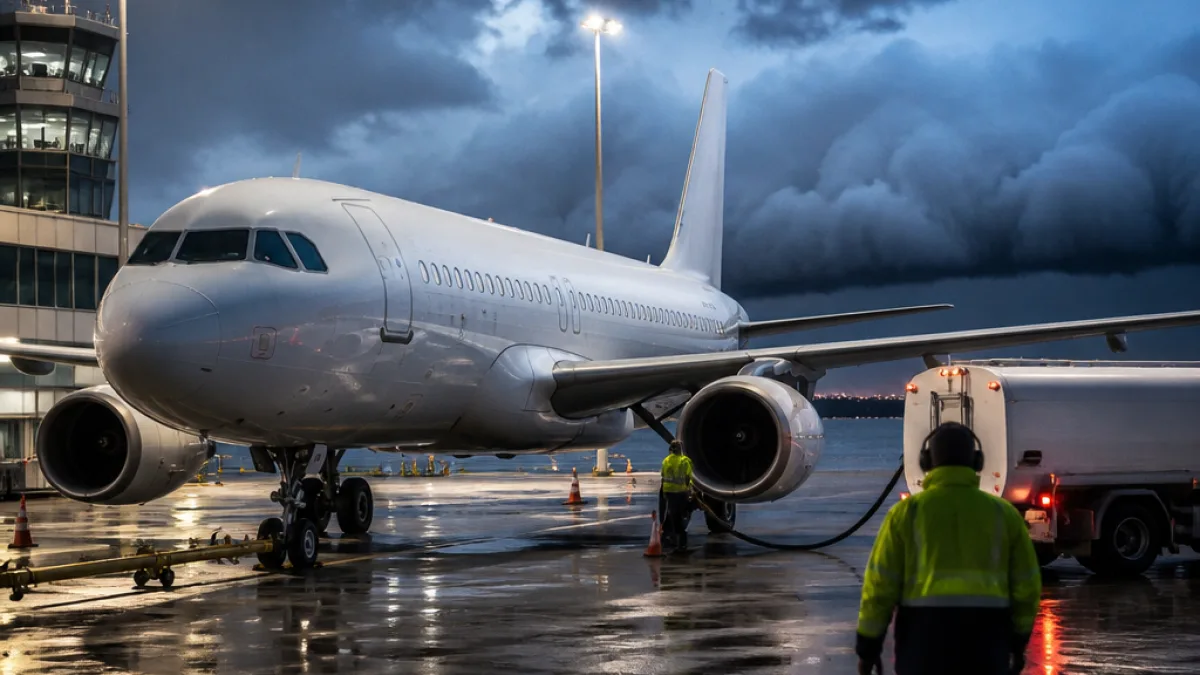
Ryanair flight FR2955, scheduled from Dublin to Bristol, was diverted to Alicante–Elche Airport after the crew abandoned the approach to Bristol amid severe weather associated with Storm Boelo. The short-haul sector, which normally takes under an hour, ended more than 900 miles from its planned destination when the Boeing 737-800 landed in Spain in the early hours of Sunday.
Flight details and sequence
The flight departed Dublin Airport at about 22:00 local time on Saturday 24 October 2026. Flight-tracking data cited in contemporary reporting showed the aircraft climbing to around 27,000 ft before initiating descent towards Bristol. The approach was abandoned while the aircraft remained above FL200 (20,000 ft), it entered a holding pattern and then returned to cruise altitude as controllers and operations teams evaluated diversion options.
After performing a U-turn, the aircraft continued south and touched down on Runway 10 at Alicante at approximately 02:15 local time on Sunday, having been airborne for nearly three hours after leaving Dublin. Contemporary reports identify the aircraft as a Boeing 737-800 registered 9H-QDK.
Earlier sectors and operational knock-on
The aircraft’s earlier schedule increased the operational complexity: the same airframe had operated FR2954 from Alicante to Newquay on Saturday, then diverted to Dublin after an unsuccessful attempt to land at Newquay because of severe gusts. Following that diversion, the aircraft later operated the Dublin–Bristol leg that was itself diverted to Alicante.
- Carrier: Ryanair
- Flight: FR2955
- Planned sector: Dublin (DUB) – Bristol
- Actual diversion: Alicante–Elche Airport (ALC)
- Aircraft: Boeing 737-800 (registered 9H-QDK)
- Departure: ~22:00 local time, 24 October 2026
- Arrival diversion: ~02:15 local time, 25 October 2026
| carrier | origin | destination | diverted to | aircraft |
|---|---|---|---|---|
| Ryanair | Dublin (DUB) | Bristol | Alicante–Elche (ALC) | Boeing 737-800 (9H-QDK) |
Reports say FR2955 was not the only Ryanair service affected by the storm over the weekend; another Ryanair flight bound for Edinburgh from Faro was also forced to divert due to powerful winds. Storm Boelo produced strong, variable winds and disrupted operations at multiple UK airports, prompting diversions, cancellations and delays across the network.
Operational implications
The diversion highlights several operational challenges LCCs face during extreme weather events: off-schedule aircraft rotations that leave airframes and crews out of position, the need to identify available diversion airports across a wide area, and the passenger disruption that follows even on very short sectors. The aircraft’s earlier diversion from Newquay to Dublin, followed by the Dublin–Bristol diversion to Spain, illustrates how a single airframe can be subject to a cascade of out-of-position sectors within a day.
Ryanair has been contacted for comment in contemporaneous reporting. Airports and meteorological services issued warnings for multiple UK locations as Storm Boelo tracked across the country; operators and air traffic control used contingency procedures as wind and gusts affected several approaches.
No official investigation or safety classification of the Dublin–Bristol diversion has been published in the immediate reports. The event remains a relevant case for airlines, airports and route planners assessing resilience and contingency arrangements for short-haul leisure and regional rotations when severe weather is forecast.