
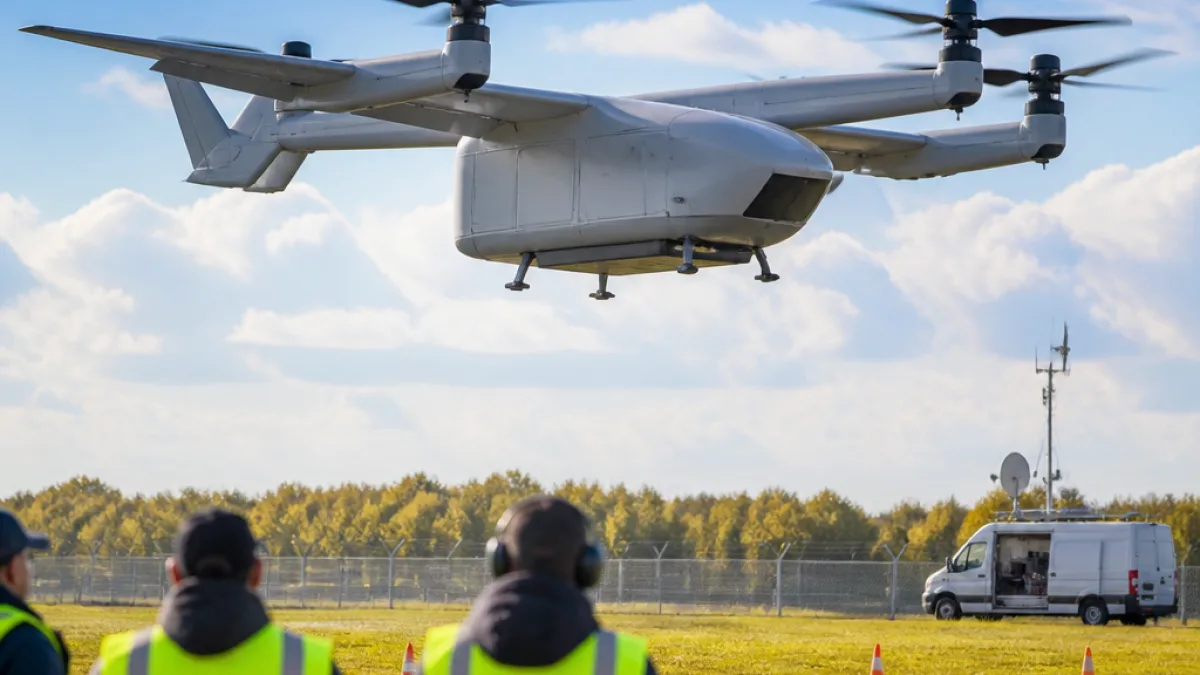
Brazilian eVTOL developer Moya says its full-scale 256 cargo prototype has completed a transition flight that tested propulsion, aerodynamics and flight controls while switching between hover and cruise flight modes. The company presented the milestone as a key step towards operational use for medical, humanitarian and commercial logistics.
How the 256 works
Unlike tilt-rotor or tilting-wing designs, the 256 uses a tandem-wing layout and rotates its entire fuselage to change between vertical and forward flight. Two pairs of electric propellers provide both vertical lift and forward thrust, a configuration Moya says allows the aircraft to operate from confined sites such as a soccer field without a runway.
“Completing the transition with the full-scale Moya 256 is a major milestone toward operational deployment,” Alexandre Zaramela said
Moya traces the 256’s development from a technology demonstrator that first flew in November 2023. The company reports the full-scale 256 has accumulated nearly 200 flights, and that, counting subscale and other test airframes, its test campaign totals almost 500 flights.
Cargo capability, funding and customers
Moya positions the 256 and a larger sibling, the 760, for roles including medical and humanitarian supply missions, e-commerce and industrial logistics, and agricultural tasks. Published performance figures for the platforms are:
- 256: 30 kilograms payload up to 160 kilometres
- 760: 190 kilograms payload up to 190 kilometres; a hybrid-electric 760 extends range to 300 kilometres
The company’s October 21 announcement also listed planned payload capacities of up to 80 kilograms for the 256 and 200 kilograms for the 760. Moya said it has received 119 letters of intent from prospective customers, including Canadian logistics group N2 Infrastructure Technologies.
Development has been supported by the Brazilian innovation agency Finep, which contributed a $2 million grant as part of the $5.8 million Moya has raised so far.
Timing and next steps
Moya said work on a production-conforming 760 prototype is underway and that it intends to fly the 760 prototype by year-end. The company has stated an objective to achieve type certification and service entry in 2027.
| item | 256 | 760 |
|---|---|---|
| payload (stated) | 30 kg (planned up to 80 kg) | 190 kg (planned up to 200 kg) |
| range (stated) | 160 km | 190 km (hybrid: 300 km) |
| test flights logged | 256: nearly 200; all test aircraft: nearly 500 | |
| funding cited | US$5.8 million raised to date; Finep grant US$2 million | |
| commercial interest | 119 letters of intent; includes N2 Infrastructure Technologies | |
| certification target | type certification and service entry in 2027 (company target) | |
The company frames the 256 as a short-range, all-electric logistics aircraft and the 760 as a larger asset for heavier payloads and extended missions. Moya’s timeline signals an aggressive schedule that, if met, would place its conversions and manufacturing plans into the market well ahead of many competing cargo eVTOL concepts.
For operators, logistics providers and air-mobility planners, the 256’s ability to operate from small sites and its growing test history will be closely watched as regulators and customers evaluate performance, safety and the business case for electric vertical cargo aircraft.