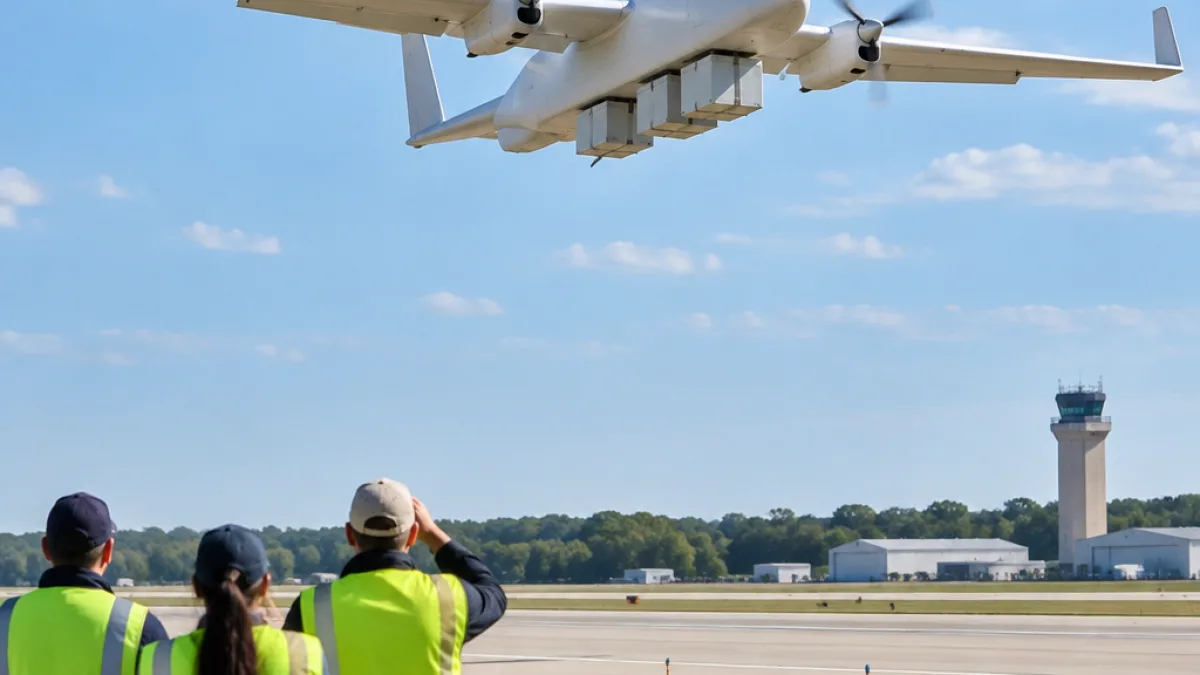
Windracers has completed what it described as the first autonomous beyond visual line of sight (BVLOS) flight in the newly established Indiana Drone Corridor, marking an operational milestone for the British company’s heavy-lift unmanned aircraft in the United States.
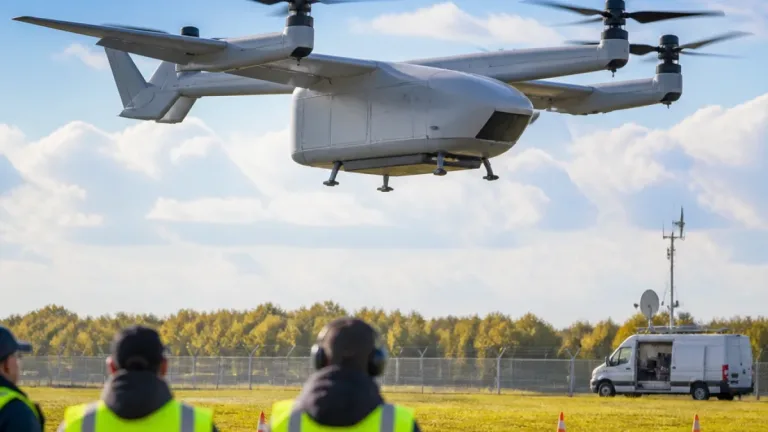
The flight was carried out by a Windracers ULTRA aircraft owned by Purdue University. It covered more than 50 miles within the corridor, which extends for more than 200 miles across southern Indiana. The operation took place during the corridor’s opening event at Terre Haute Indiana Airport.
Windracers said the flight demonstrated the use of the corridor for autonomous-aircraft testing, rather than announcing a commercial cargo service. The aircraft also took part in an autonomous parachute-resupply display witnessed by FAA Administrator Bryan Bedford, Indiana Governor Mike Braun, US Senator Todd Young and US Representative Mark Messmer.
A test environment for autonomous aircraft
The Indiana Drone Corridor is one of two new US test sites for unmanned aircraft systems announced by the US Department of Transportation and the Federal Aviation Administration (FAA) in January 2026. The Indiana Economic Development Corporation and the Applied Research Institute were named as the organisations managing the airspace corridor.
It joins existing unmanned-aircraft test sites in Alaska, New Mexico, Nevada, New York, North Dakota, Texas and Virginia. The corridor gives companies and research organisations a defined environment in which to develop and assess autonomous-aircraft systems beyond the direct visual observation of a pilot.
| Flight detail | Information |
|---|---|
| Aircraft | Windracers ULTRA |
| Aircraft owner | Purdue University |
| Operation | First autonomous BVLOS flight in the Indiana Drone Corridor |
| Distance flown | More than 50 miles |
| Location | Indiana Drone Corridor and Terre Haute Indiana Airport |
Aircraft designed for autonomous cargo operations
The ULTRA has an aluminium airframe and a 33 ft wingspan. Windracers describes it as an autonomous aircraft capable of flying without a pilot on board and carrying out cargo-drop missions through a three-bay drop-door configuration.
The aircraft’s stated capabilities place the demonstration at the intersection of autonomous flight testing and air cargo development. However, the operation described by Windracers was a corridor test and display flight; it was not presented as the start of a scheduled freight operation or as evidence that the aircraft has completed any wider certification process.
“The Midwest and Great Lakes region already knows how to build things that matter. This initiative connects that manufacturing strength with the flight testing, defence expertise and research capabilities needed to bring new aviation technologies to market.”
Andrew Kossack, CEO and President of the Applied Research Institute, said the initiative was intended to support innovators in developing systems, proving them in relevant environments and building them in the Midwest. He said the programme would also create opportunities for companies and workers throughout the region while strengthening the US defence and industrial base.
Purdue University is working with Windracers through the AIDA Program on the safety and efficiency of autonomous air systems. The Indiana Economic Development Corporation and Applied Research Institute are responsible for managing the corridor, providing an organised setting for private and public organisations developing unmanned-aircraft technology.